Monday, June 28, 2010

FinReg: Trying to Legislate Adulthood

To recap:


A lot of people wanted to have things, and didn't have the money. Houses, consumer goods, office buildings, government benefits. Instead of doing what an adult would do, which is wait, save some money, and buy the things they needed and wanted when they could afford them, they borrowed the money to get the things they wanted right away. To be fair, I suppose that there was a big system set up to encourage them to do this. Advertising, government policy of various types, some cultural pressure, political pressure, we can go into this if you want.


There were plenty of people around willing to loan them the money to do this. Mortgage brokers, credit card companies, commercial banks, government bond dealers, politicians. The adult thing to do would have been to say "no" to some of them, but once again, the system was set up for "yes", and a lot of these loans got written, and there were a lot of charges put onto credit cards.


So, what to do with all of these mortgages and credit card debt and soveriegn debt that were taken out by people that could not reasonably pay them back? Well, an adult thing to do would have been to take the high risk ones, bundle them together with other high risk ones, and charge enough interest to compensate the lenders for their risk. Instead, they were mixed in together with a lot of good loans, and then the ratings companies, and we all know who they are, gave them a nice high rating, and the interest rates were kept nice and low, and no one, well almost no one, could tell the good from the bad. Pretty immature, to hide all of those bad loans in with the good and not tell anybody about it but that's what happened.


These bundled loans of various types (CDO's, commercial paper, sovereign debt) were traded back and forth, and a whole system of insurance, derivatives, and other financial instruments were developed by the so-called financial engineers, and this whole system was basically done with play money, since the underlying financial instruments were only loosely connected with adult-based reality.


Then, when the system collapsed, the government(s) involved said to the people that perpetrated it: "Do-Over, you do not have to suffer the consequences of your childish actions, all is well, we will take care of this and you can go back to your play money game"  The governments fabricated a lot of money out of thin air, and the game started back up again. Where did the goverments involved get this money? Well, rather than doing the adult thing, and getting it from the people that benefited from the system by raising taxes or interest rates to re-adjust the system, they borrowed it from someone who would not know the difference, the nation's 3-year olds. Here is the big injustice, as I see it.


Now, a law has been passed, FinReg, so called financial regulations, which basically set out a few rules to re-introduce adulthood into each of the layers of the system: More regulations at the bottom levels, put some controls at the mid-levels. Was there any regulation put on at the top level, to keep the government from saying "do over" and bailing out the next catastrophe? There is no talk of this. There is also minimal talk of going back through the system and making people accountable for the collapse of the system as it previously existed.....


So will all of this work? Oh, maybe in a broad sense to at least put a bureaucratic drag on the system, maybe there is some benefit to that...but until a system is set up to encourage people to be adults, I think we have not seen the end of it.


I will go back to writing about oil. If I am wrong on any of this, please feel free to comment.


Disclosure: none

Wednesday, June 16, 2010

FTO: Maintenance People Need Love Too

Awhile back we developed a little model to predict the profitability of Valero, which worked quite well, based on the relationship between the company's net operating income (NOI) and a weighted average WTI/finished products crack spread. Maybe we can learn something by applying the same technique to Frontier:

Here is FTO's NOI and the same refining margin model that we developed earlier:


and when we adjust the model for industry refinery utilization and seasonality, we arrive at the following:


In fact, when you do the regression analysis, FTO's net operating income is even more strongly correlated to the refining margins than VLO's was. R-squared was 0.82, compared to Valero at around .66.

Based on the model, we would then expect them to benefit even more than VLO from the current improvement in refining margins, which as of a week or so ago were getting into the $11 per barrel range, and if you plug in the same assumptions we did earlier into FTO's NOI equation, you get earnings of about the same level as they saw in the the fourth quarter of 2006, or the first quarter of 2008, when they were earning somewhere in the mid-40's per share.

But, the consensus of the analysts right now are for earnings in the upper 20-s. What's happening?

If you look at the periods of time they deviated from the model, the second quarter of 2008 and also, really, the last two quarters, and review their management statements these are both periods during which they were experiencing some maintenance issues at their refinery in Cheyenne.

FTO is a lot smaller company. They do not have retail locations, a pipeline network, or any other noticeable diversification, and make their money, or not, on the basis of how good of a job they do of keeping their refineries running. Their Cheyenne refinery makes up 1/3 of the company's total capacity, and they are doing a lot of work to make this operation more efficient and deal in a better way with heavier crude oil.

So, in a real sense, the ability of FTO to get back to what they have been historically doing comes down to the ability of somebody to turn a wrench. Makes you want to give the maintenance people a little more respect doesn't it? Actually, it makes you want to invite the maintenance people to the next earnings conference call to find out how the work is going. It would not be completely unheard of for these guys to be overachievers and get their work done a little faster, and one of the analysts is actually optimistic that this can be done, and they will end up in the 40's somewhere for earnings this quarter.

The last question is: What would be the better investment, FTO or VLO? Well, at a price of 18 and expected earnings this year of about $1 per share, VLO is the less risky of the two. With a current price of 14 and earnings prediction in the mid $0.20-s, FTO is a bit more expensive right now. The possibility of a pleasant surprise for FTO is already in the price.


Keep in mind, of course, that the market does not always care how much money a company is making, and NOI does not always transfer down to EPS because of write offs, and various other things that are going on in a company, including where the refinery is, and what your prediction is going to be for refinery margins and crude oil pricing.

But, in this case, what we really need is the phone number of FTO's Cheyenne maintenance shop. If it rings and someone picks up, it means they have spare time to answer the phone, and things are nice and peaceful, which, if you are a maintenance guy, means you are good at doing your job. If it rolls to voice mail, it means they're busy. That can't be good, in this case.

Monday, June 7, 2010

Marginal Complexity in the Refining Industry


Am I the only guy still around that remembers that plate spinning act that used to be on TV?


Here it is:
http://www.youtube.com/watch?v=Zhoos1oY404

We used to watch this stuff in the 60's for entertainment....

Anyway, the essence of the act is that this guy has the capacity to spin X number of these plates and bowls on the sticks.... You have to keep the ones you have going, then gradually add complexity until you get the whole thing up and running. For you and I, spinning one plate would be difficult, but this guy is an expert, and he can do a lot of them.....By "marginal complexity", we mean that the problem gets increasingly difficult with the addition of the one plate...

So, would it be much of an act if he only spun four bowls instead of five? The system would be running at a state slightly below its maximum capacity. Well, the guy has to be talented, it is true, to do the four bowls, but you would not be quite as impressed, and perhaps for him, the act would be a bit more boring.

The situation in the refinery business right now is a lot like this. There are only four bowls spinning. It takes quite a bit of effort to keep the system spinning at its current level, but there is no need to add the extra complexity, which you can only do temporarily anyway, and so the guy is just going to stand there for awhile and keep the fourth bowl spinning without adding the fifth.....he could add another, but the system does not require it right now...

So I think we're going to go another week as follows: The capacity utilization will be 89 percent or so, the demand will be not quite what it was in 2007 but higher than 2009, and the imports will be about what is needed to keep inventories about where they are. Right now, there is plenty of fuel around, the contango is still in effect, but the market is well supplied and there is no compelling reason to store oil if the buyers think there will be a demand decline later because of a double dip or something.... I think a lot of the emotion in the marketplace to keep oil around went away a month ago when the price collapsed.....

So we will see what happens. Keep in mind that if he does not go back and do maintenance on his bowls, he will lose one.... so he will do that for awhile at least, even if he does not add the fifth bowl....and by fall, maybe he will go back down to 3 bowls and a couple of plates, and have some spare time, to fool with the spoons and glasses....

Thursday, May 27, 2010

Valero, Refining Margins, and Making Money

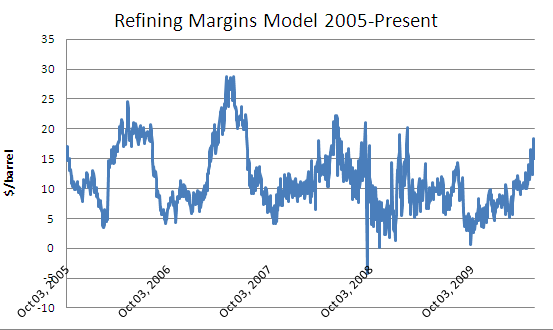
It's not too hard to develop a little model of a refiner's gross variable margin: You can approximate the cost of the feedstock with WTI and if you know roughly their product mix, you can estimate the average sale price of the output, which gives a weighted-average crack spread on the finished products.


Of course, the actual gross variable margin varies a lot by company, depending on the product mix, and even by individual production unit. But, without complicating the problem too much, the model for the past few years has looked like this:


As you can see, within the last few weeks, it has recovered from the beat down experienced in late 2009 and has been looking a little better. Within the last few days, it's fallen to a bit under $11 per barrel. Note that It's not exactly the RBOB or HO crack spread, because it's a weighted average of the product mix, but it is a pretty good approximation of whether people are making any money in this business, particularly if you know the conversion cost per barrel.


Valero is an interesting company to look at sometimes, it's the largest independent refiner, they do very little upstream, and their claim to fame is the refineries they run along with the retail operations in the western 2/3 of the country. The company was put together a few years ago to buy low-entry-cost but relatively inefficient refining assets, a move which looked brilliant in 2006 when capacity was short, but for the last couple of years has been really not very good at all. They are a high-cost producer, they have lost money 5 out of the last 6 quarters, and they have recently taken steps to get out of the rut they are in by diversifying into some ethanol and alternative fuels, plus sell their worst performing refinery in Delaware.


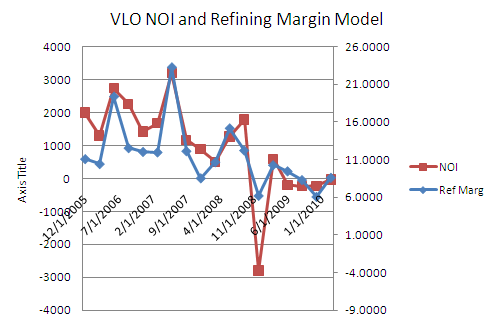
Our refinery margin calculation corresponds pretty closely to Valero's Net Operating Income (per their quarterly reports). In fact, you can see that it's the main driver of their profitability, This is not rocket science, no one is making money in retail so that is not much of a diversification.... You can see that in 2005-2006 they overachieved a little bit, in that period, capacity utilization was  higher than it is right now and they had a bit more pricing leeway. Valero's production cost, per their financials, is usually between $6.50 and $7 per barrel. Some of the more efficient majors can get their product converted for $5-6, which means that they can stay profitable while VLO bleeds money.


An even better approximation can be made by adjusting the model for the industry refinery utilization, which is a measurement of price strength (low utilization means terrible pricing) and by subtracting out the seasonality.  R-squared for this little model is about .66, pretty good. It is not at all unheard of for profitability to be off a bit in timing, like it was in 2008, and also not at all unheard of for people to dump costs into the books if they know they are going to have a bad quarter, so maybe that is what happened in late 2008 when the market collapsed.


The very fact that the profitability of this outfit is so predictable is just an indication that their business is so commoditized, and to the credit of the management they are trying to make some changes in their business to lower their conversion costs and get into some other line of business to get them out of the equation. In the meantime, we can use this information to try to predict what they're going to do in the upcoming few months. Of course it depends on what you expect the WTI and products prices to be between now and the end of the quarter, but based on a reasonable set of assumptions (an $11 dollar weighted average refinery margin and 87 percent utilization) the model suggests their NOI for the June quarter is going to be in the neighborhood of $900M, which is the kind of quarter they had in early 2008, when they made in the low 40's per share. The analyst consensus for VLO for the upcoming quarter: the low 40's per share. They have some prospects to do a little better. The refinery margin model has averaged $12.71 up until May 14th.... We'll check back at the end of June to see how they're doing. Also, we should be able to unearth this model in a couple of years and see how good of a job they did in diversifying...because their profitability will correlate less well with the model.


Of course,  all of this might or might not transfer directly to the stock price because these guys are bound to take a charge for discontinued operations, and the market itself is subject to chaos,  Still it is nice to know a little ahead of time whether they are going to make a little money, and as time goes on, I am sure the management hopes that the changes can get them more consistently profitable through all parts of the business cycle which, despite rumor to the contrary, obviously still exists.


Disclosure: none

Thursday, May 20, 2010

Historic Dance: WTI and the DJIA


You probably noticed the unusually strong correlation between the changes in the WTI price and the DJIA average that has been occurring lately. The stat people can put a number on this, it's the correlation coefficient R-squared. A value of 1 is perfect, a value of 0 is no correlation. You can pretty easily get the number for any 10-day period as far back as you want to go. "Perfect" may be either in lock step, where one goes up followed by the other, or "perfectly divergent" in which an increase in one occurs with a decrease in the other.

Between 2000 and now, the correlation between the daily price change in WTI and the Dow has averaged 0.14, pretty weak. The prices of one typically do not move in conjunction with the prices of the other very much. The R-squared value for the above 10-day period was .82, quite strong, as we have noticed.

If you go back over the last couple of years, back to early 2008, there were seven time periods during which there was a strong correlation between the WTI price change and the Dow price change, and the baseline value is much higher than the historical average.


Of these "major instances", 6 of the 7 were similar to the case above, The lone exception was the period in May of 2008 during which the WTI price and the DJIA price were strongly divergent;


In fact, historically, this was the more common occurrence. Take this example, which occurred during the Iraq invasion of Kuwait and run up to Operation Desert Storm:


There were four instances between August of 1990 and September of 91 during which the two markets danced either together, or divergently.

But, the point is this: As far back as the WTI records go, to 1983, the incidences of the WTI and Dow being closely correlated (defined by an R-squared of greater than .7) are exceptionally rare. Even during the DJIA meltdown in 1987, WTI scarcely moved. Since 1983 there have only been 16 events of this nature, and 7 of them have occurred in the last 2 years, since the financial problems started to show up in the global economy.

So for the time being, the caution for parties interested in either index is: we are witnessing an unprecedented dance between the WTI price and other measurements of market value. No doubt both are being influenced by the same market emotion or other underlying factor, i.e. the strength of the dollar and general stability in the financial system. The strong correlation is undoubtedly a sign of continued stress in the financial system and other markets.

Tuesday, May 11, 2010

Nominal Capacity vs. Stated Capacity

The stated system capacity, by which the refinery utilization is computed, is about 17.4 mbpd.

If you take the stated refinery utilization, which last week was 89 percent, and compute the theoretical inputs (purple line) there is about a 2 percent gap, which means the system is not actually taking in as much crude oil as the nominal calculation says that it should.

This gap has increased in the last few weeks as the system comes out of its slumbering mode.....it represents some refinery inefficiency, and more likely, represents the fact that the system is not capable of taking as many barrels per day as the reports state.

Monday, May 3, 2010

Fun Week for the Inventory Report


First of all, we have the oil disaster unfolding before us out in the GOM. and we will finally start getting some kind of number associated with the lost production as well as the effects of the nearby pipeline that they had to shut down when this thing started to burn. We did not see it in last week's numbers but I think the domestic production will be down around 5.3 which is .1 mbpd less than it was.

No one is talking about it but the burning platform is only about 100 miles from the LOOP, and as that slick gets bigger and bigger, there will have to be some effects on the movements of tankers in this area.....Luckily the LOOP is farther west, and the current is pushing the slick east (toward Florida's pristine beaches) It is anyone's guess how big and deep this mess would have to be before they talk about shutting down the LOOP but if they do, we are talking about 3 mbpd not coming into the country via that path. I think about 1.4 mbpd typically comes in around Houston and the remaining roughly 1 mbpd elsewhere, just as a reference.

Secondly we have the issue of refinery utilization. We talked last week about the refiners now being up to 89 percent, which is as high as I thought they were going to be at the peak this year, but per the graph above, this is actually comparable to the pre-recession average, so that system is up and running at least for the moment. As a result we are going to have to see something approaching 15.3 crude oil inputs to refineries....

Thirdly, the driver behind the refiners gearing up is obviously this unleaded demand situation, which was up over 3% year on year, and not quite up to pre-recession levels but getting pretty close, I think. The archive of doom says that the 2008 products supplied for this week was 9.3 and we are talking about 9.2 as of last week....

So, assuming last week was not a blip we are looking at the potential for the crude oil inventory change being right about even and if the imports are not 10 mbpd we are talking about a drawdown, and that would really throw a bit of excitement into this marketplace which has seen 12 straight builds in inventory.

There is an underlying sub-plot on distillates: Unleaded demand has picked back up to the pre-recession levels, but diesel has not. You are going to see bigger and bigger builds in the distillate inventory because of this.


So, we will have to continue to watch the news and wait to see what happens but there may be some surprises on the report this week....

I see that the front contract is back up over 86. maybe you will see 90 in a few days.....More fun later..