We wrote in a previous blog entry about the epic catastrophe that befell WNR's decision to buy a 72Kb/d refinery in Yorktown VA.
To recap, these fellows borrowed $1.12B and bought this refinery at the absolute peak of the market, paying on the order of $20,000 per barrel of capacity. This spring, they finally gave in and shut the doors on the place, they are going to use the location as a terminal, and they are going to "monitor conditions", with the idea that they could restart the place.
In the meantime they have the ongoing problem of the $1B of long term debt.
They had a stock offering this spring which managed to raise $150M thus paying off the current portion.....
Their interest expense is $34M per Quarter, as of the most recent quarter. this amounts to approximately $2.75 per barrel of refined product....
So....
As long as the refining margins stay high enough so that they can continue to service the debt, plus provide a little profit, they can make the current situation last for a long time. This is obviously not a desirable situation, but they have some prospects to make it work.
Their strategy also involves rolling out the long term debt that is coming due by issuance of five-year notes, at high interest rates. The notes issued in the first quarter this year had a face value of more than 11%, so on that basis, if you really, really had confidence in this business, this would be a pretty interesting way to play it.
The question comes up: Could the sell the plant for some amount of money, and based on the analysis we did earlier on the current value in the marketplace for refinery capacity, it is unlikely they could get more than 4000 per BOD of capacity, or about $280M for the plant. This is so far below the value of this place on WNR's books that the likelihood of it happening is practically zero.
WNR has also been quite successful with working with their bankers using a revolving credit arrangement to roll out the remainder of their long term debt as it comes due. I suppose if you look at it from the bank's point of view, as long as WNR is able to service the debt, it makes no sense to pull the rug out from under them under the theory that if you owe someone $100 you and cannot pay it back you have a problem but if you owe someone $1B and cannot pay it back, THEY have a problem.... so as long as the margins are strong enough that WNR can continue to service the debt, the game will continue.
At some point, in theory, refining margins will go back up to some reasonable level, the light/heavy crude oil differential will re-widen again, and they will be able to start this refinery back up, and at that point it will have some value in the marketplace.
Until then, nothing is going to happen on this, the situation is not good, but it is stable, and a plan is in place for the medium term survival of the company, until such time, if any, that the margins get back to where they were.
Note: If we do have a double dip, or even worse, if we get into a situation where the feedstock costs go way up but the refining margins stay stable, then these guys are going to be in a heap of trouble, like they used to say.
In the meantime, Morgan Stanley likes their plan, they have upgraded the stock, and that is another interesting development. We will see what happens.
Friday, October 22, 2010

Monday, October 18, 2010
MRO: What to do with $900M
Marathon Oil (MRO) recently unloaded a lot of gas stations and a small refinery up in Minnesota, and now have on their hands $900M. There are a few alternatives as to what to do with the extra cash.... and MRO being the conservative types that they are have no doubt considered the following alternatives:
Share Buyback
Currently at 36 the market is anticipating earnings of about $2.3B for the year, and by reducing the number of outstanding shares to 684 million by buying back $900B at the current price, at the current PE, should result in a stock price of about 47 per share.
Increased Dividend
At the current stock price of about 36, and a current dividend of about $1 per share, the yield on this conservative stock is about 2.8%. The question is: how much, if any, to increase the dividend? An increase of 25 cents/share would be sustainable with the business currently like it is for 4 years (at the current number of shares outstanding) and at the same yield, should result in an increase in the stock price to about $45 per share. Note: At the current price and yield, the market is assuming that MRO will have zero growth going forward, with the economy in its current state. Any growth prospects in this business could be factored in for some additional pricing improvements.
Acquisition
Using the optimistic assumption that MRO could buy some business that has a 10% ROI in the first year, which is a wildly optimistic assumption, the value in increased earnings for the company will be $90M per year, which at 709 million shares comes out to a mere 13 cents per share. At the current PE, 13.2 times earnings, the increased stock price from this type of investment would only be $1.67 per share.
Note: Using the $900M to pay down their long term debt would theoretically have exactly the same impact on the stock if, and it is also a big if, the reduced interest expense by retiring the debt made its way similarly to the bottom line....
Note: Using the $900M to do some sort of debottlenecking project in their current operations will be evaluated on exactly this basis as well: If it is a more attractive investment, relative to the stock price, than just buying back their own shares, they will do so rather than make the investment internally.
The second question comes up: What ROI would an investment need to make in order for the impact on the stock price to be the same as buying back shares, and the answer is, something on the order of 50 percent ROI, which tells me, at least that the likelihood of this alternative happening ought to be next to zero, unless they are really confident..... for that matter, if they can find an investment that will return 50 percent, I hope sincerely that they tell us what it is, so we can invest in it ourselves.
The Bottom Line
Either the stock buyback or the increased dividend could happen, more likely the stock buyback, because the conservative management will correctly not want to get the widows and orphans accustomed to the extra 25 cents per share....
In either case, it makes sense for this stock to be trading up around 47, from its current 36.
Note: The world is chaotic, and there are no guarantees on anything.....
Side issue: What kind of an economy are we in where the management will be greatly advantaged to shrink the company rather than position itself for growth in some way....
Share Buyback
| 709,000,000 | Shares Outstanding |
| $ 2,390,000,000 | Current Anticipated Earnings |
| $ 3.37 | Current Anticipated EPS |
| $ 36 | Current Stock Price |
| 684,000,000 | Shares Outstanding After Buyback |
| $ 2,390,000,000 | Anticipated Earnings |
| $ 3.49 | EPS after Buyback |
| 13.5 | PE |
| $ 47 | Anticipated Stock Price after Buyback |
Currently at 36 the market is anticipating earnings of about $2.3B for the year, and by reducing the number of outstanding shares to 684 million by buying back $900B at the current price, at the current PE, should result in a stock price of about 47 per share.
Increased Dividend
| Current Dividend Yield | 2.8% | |
| Dividend | $1.00 | per share |
| Stock Price | $35.71 | Current Stock Price |
| Current Yield | 2.8% | |
| New Dividend | $1.25 | per share |
| New Stock Price | $44.64 | After Dividend Increase |
At the current stock price of about 36, and a current dividend of about $1 per share, the yield on this conservative stock is about 2.8%. The question is: how much, if any, to increase the dividend? An increase of 25 cents/share would be sustainable with the business currently like it is for 4 years (at the current number of shares outstanding) and at the same yield, should result in an increase in the stock price to about $45 per share. Note: At the current price and yield, the market is assuming that MRO will have zero growth going forward, with the economy in its current state. Any growth prospects in this business could be factored in for some additional pricing improvements.
Acquisition
| Shares Outstanding | 709,670,000 |
| Investment | $ 900,000,000 |
| Investment ROI | 0.1 |
| Increased Earnings/Yr | $ 90,000,000 |
| Increased Earnings/Share | $ 0.13 |
| PE | 13.2 |
| Increased Mkt Cap | 1.67 |
| Current Stock Price | $ 36.00 |
| New Stock Price | $ 37.67 |
Using the optimistic assumption that MRO could buy some business that has a 10% ROI in the first year, which is a wildly optimistic assumption, the value in increased earnings for the company will be $90M per year, which at 709 million shares comes out to a mere 13 cents per share. At the current PE, 13.2 times earnings, the increased stock price from this type of investment would only be $1.67 per share.
Note: Using the $900M to pay down their long term debt would theoretically have exactly the same impact on the stock if, and it is also a big if, the reduced interest expense by retiring the debt made its way similarly to the bottom line....
Note: Using the $900M to do some sort of debottlenecking project in their current operations will be evaluated on exactly this basis as well: If it is a more attractive investment, relative to the stock price, than just buying back their own shares, they will do so rather than make the investment internally.
The second question comes up: What ROI would an investment need to make in order for the impact on the stock price to be the same as buying back shares, and the answer is, something on the order of 50 percent ROI, which tells me, at least that the likelihood of this alternative happening ought to be next to zero, unless they are really confident..... for that matter, if they can find an investment that will return 50 percent, I hope sincerely that they tell us what it is, so we can invest in it ourselves.
The Bottom Line
Either the stock buyback or the increased dividend could happen, more likely the stock buyback, because the conservative management will correctly not want to get the widows and orphans accustomed to the extra 25 cents per share....
In either case, it makes sense for this stock to be trading up around 47, from its current 36.
Note: The world is chaotic, and there are no guarantees on anything.....
Side issue: What kind of an economy are we in where the management will be greatly advantaged to shrink the company rather than position itself for growth in some way....
Tuesday, August 3, 2010
Frontier Oil: Reliability Engineering Revisited
We are greeted with the following press release from Frontier Oil this morning:
investor.shareholder.com/fto/releasedeta...
In light of our previous calculations on this company, based on the current crack spreads, the effect of this on NOI, if the unit is down for the two weeks suggested in the press release, about 41Kb/d times $11 per BOD crack spread somewhere in the neighborhood of $6.5MM in lost NOI due to the effect of the lost production at roughly 80% utiilization. With a forward PE of 10, this equates to less than a dollar on the stock price, which is still relatively small given the normal market fluctuations.
But here is an example of the very thing that we discussed in our instablog of June 17 on the importance of reliabiilty engineering directly influencing NOI and therefore the stock price. This company, linked intimately with the refining crack spread, needs to keep their equipment operating in order to have a business.
They will announce their earnings in early August, this issue will be reflected in the third quarter operating results.
HOUSTON, Jul 28, 2010 (BUSINESS WIRE) -- Frontier Oil Corporation (NYSE:FTO) experienced a fire this morning at approximately 5:40 a.m. MDT in the crude unit at its Cheyenne Refinery. The fire was extinguished within approximately one hour by refinery and city fire personnel. There were no injuries. The cause of the fire and extent of the damage is currently being assessed with preliminary estimates indicating the crude unit outage will be approximately two weeks.
Frontier operates a 135,000 barrel-per-day refinery located in El Dorado, Kansas, and a 52,000 barrel-per-day refinery located in Cheyenne, Wyoming, and markets its refined products principally along the eastern slope of the Rocky Mountains and in other neighboring plains states.
investor.shareholder.com/fto/releasedeta...
In light of our previous calculations on this company, based on the current crack spreads, the effect of this on NOI, if the unit is down for the two weeks suggested in the press release, about 41Kb/d times $11 per BOD crack spread somewhere in the neighborhood of $6.5MM in lost NOI due to the effect of the lost production at roughly 80% utiilization. With a forward PE of 10, this equates to less than a dollar on the stock price, which is still relatively small given the normal market fluctuations.
But here is an example of the very thing that we discussed in our instablog of June 17 on the importance of reliabiilty engineering directly influencing NOI and therefore the stock price. This company, linked intimately with the refining crack spread, needs to keep their equipment operating in order to have a business.
They will announce their earnings in early August, this issue will be reflected in the third quarter operating results.
Tuesday, July 20, 2010
Marathon Upstream vs. Apache and Andarko

Here is a little spreadsheet comparison between the Marathon Oil upstream business, vs. its competitors Andarko and Apache.
Andarko has a much higher debt load, market capitalization of the three are quite similar, but the profitability of MRO and APA are better, probably because Andarko has incurred a higher debt load.
Note: The Market Capitalization is for MRO total company, including the refining business, as is the long term debt amount.
Tuesday, July 13, 2010
Additional Analysis of the HOC Tulsa Refinery Acquisitions
Here is some detail on what appears to have been really a pretty good deal.
In April of 2009 the Sunoco deal was done. The product line included their line of lubricants and specialty materials, and the 85,000 bpd refinery was sold for $157 million, which is a bit more than $2000 per BOD capacity.
In October of 2009, the Sinclair deal was done, the additional 75,000 BOD of capacity was bought for $183 million, a rate of $2444 per BOD capacity...
By the time the rationalization and product line conversions are done, the project will have 135,000 BPD of capacity, which they bought for a total of just under $3000 per barrel, not including the cost of some of the conversion that they will have to do.
The company did have to incur some debt, $400M of notes that come due in 2017. They were able to raise another couple hundred million by the sales of their interest in a pipeline, and the issuance of stock. They also chipped in $54M in cash on the deal.
Keep in mind that per our earlier analysis, WNR paid $19000 per BOD of capacity in 2007, right before the big increase in margins, and there is an excellent chance that part or all of the company will have to be sold because the deal was so bad. Keep in mind also that this incremental capacity is valued at much lower than Valero's current capacity.
So this appears on the surface to be a much better deal despite the fact that it happened during a time when the company is going to have to take some lumps because of low utilization and poor margins. However, this doubled the size of the company, made them roughly the same size as WNR, and positioned themselves to take advantage of the upturn, if and when it comes.
In April of 2009 the Sunoco deal was done. The product line included their line of lubricants and specialty materials, and the 85,000 bpd refinery was sold for $157 million, which is a bit more than $2000 per BOD capacity.
In October of 2009, the Sinclair deal was done, the additional 75,000 BOD of capacity was bought for $183 million, a rate of $2444 per BOD capacity...
By the time the rationalization and product line conversions are done, the project will have 135,000 BPD of capacity, which they bought for a total of just under $3000 per barrel, not including the cost of some of the conversion that they will have to do.
The company did have to incur some debt, $400M of notes that come due in 2017. They were able to raise another couple hundred million by the sales of their interest in a pipeline, and the issuance of stock. They also chipped in $54M in cash on the deal.
Keep in mind that per our earlier analysis, WNR paid $19000 per BOD of capacity in 2007, right before the big increase in margins, and there is an excellent chance that part or all of the company will have to be sold because the deal was so bad. Keep in mind also that this incremental capacity is valued at much lower than Valero's current capacity.
So this appears on the surface to be a much better deal despite the fact that it happened during a time when the company is going to have to take some lumps because of low utilization and poor margins. However, this doubled the size of the company, made them roughly the same size as WNR, and positioned themselves to take advantage of the upturn, if and when it comes.
Thursday, July 8, 2010
Calumet Specialty Products: The Costs and Benefits of Differentiation
Calumet Specialty Products (CLMT) fits the same basic mold as the rest of these conversion type companies, that is, you put crude oil in one end, and finished products come out the other. They run a handful of small refineries down around the Gulf, plus have a distribution center up in the midwest. About half of their product mix is typical refinery stuff, gasoline, jet fuel, and distillates, and the other half is a lot of specialty lubricants, plasticizers, process oils and that kind of thing that go into a variety of applications, including some medical. About 3/4 of their profits come from the specialty products division, and about 1/4 from the fuels, in a good month. Production, normally, is about 50/50.
Their average refinery throughput over the last few years has been about 54,000 bpd, which is a bad 45 minutes for Valero.
I did the calculation to compute the correlation between industry refining margins and their NOI and came up with the following:

We had developed a little model by which we were measuring the extent to which these companies' NOI is related to the industry refining margins, and for CLMT the R-squared value was .10, which means, their product mix is such that they have gotten completely away from the same commodity trap that some of the other companies in this business have been in. Valero was about .66, I think FTO was up around .85 when we used the same model to compare these refiners.
The comparison between VLO and CLMT is especially interesting:

Obviously these are on a completely different scale but you can see that when the economy was relatively strong, back in 2006 and 2007, they were doing just fine, but CLMT managed to mostly avoid the catastrophe at the end of 2008.
So, what is going on here?
If you take CLMT's top line, sales dollars, for their specialty products division, and divide by the crude oil throughput, it is on the order of $100 per barrel, which given $75 per barrel crude oil costs gives them a refining margin of $25 per barrel on these products, as opposed to the Valeros of the world who are delighted to break close to even right now after overhead.
CLMT's product differentiation does come at some expense. Their SG and A expenses of about $1.41 per barrel are about 100 times higher than Valero's, on a per-barrel basis because in a lot of the markets they are in they need to do some product development and technical service, and sales service activities. Also, because a lot of their products go into more technical markets downstream, such as FDA, they need to put more effort into regulatory compliance and quality control. Also, since they cannot be transported by pipeline, product transportation is a significant line item for them every quarter, hence the distribution center in the midwest. The sum of this, about $4 per barrel, is the cost of differentiation.
CLMT also engages in a lot of hedging/derivative activities to try to protect themselves from unexpected dramatic increases in the crude oil price. According to the quarterly reports, the effects of this on their balance sheet in any given quarter can be pretty substantial, and in fact, have a couple of times exceeded the amount of money they actually made running the plant.

This is a graph of their unrealized and realized hedging effects, per barrel, for CLMT during this time frame. If you take the total hedging effects, unrealized and realized ($68 million) and divide by the number of barrels they consumed during this period, the net effect was a cost of about $0.78 per barrel, which is cheap insurance against the cost of crude oil going out of sight, and it does confirm that they are not really trying to be a trading house, all they really want to do is build a little protection into their system so that they can make money doing what they do.
So they can inoculate themselves against crude oil pricing, but they cannot inoculate themselves against a general downturn in the end-use markets, and they are still down about 20% in crude oil throughput from the top of the economy.. Since they do have a little higher costs, they have to back off of their fuel production when the margins are low, which is what has happened over the last quarter or two. A lot of their end-use markets such as automotive are also still way down from their pre-recession high water marks.
There are a few other things in the background on this: The boss is a former chemical engineer, which is a point in his favor as far as I am concerned, and a lot of the management is from the refinery industry in various capacities. They have set up the company to be managed by a "partnership", which is to say, the common unitholders do not directly vote on the management. I suppose there are drawbacks and benefits to this but one of the real benefits is that if they happen to have a bad quarter, particularly if obscured by their hedging activities, they do not need to spend a lot of time explaining to a lot of pesky shareholders what happened and can run this thing for the long term. I think the instututional ownership of this place is 11%, much lower than the big players in this industry.
They have recently entered into an agreement with Lyondell, to do the marketing and distribution activities for some of its line of specialty products. This will allow them to use their already existing distribution network to expand their market of complimentary products without having to invest in capacity, which works for both Lyondell and Calumet.
They also are paying a dividend, which at the current moment, at a price of $17 per share might end up being around 10%, which is pretty substantial, and if you look at their two-year chart, they are trading within a dollar or two of what they were in 2008, although they were beaten down a little based on the last quarter results which reflected this curtailing of their production.

I couldn't resist posting this stock chart.... which reflects the 50% loss in stock value for Valero for this period of time.... but the potential drawback is that in the event the market and/or the economy returns to some normal state, the shareholders of CLMT are probably not going to see as much capital appreciation on the upside either.
So, if you are a bit conservative, and you still insist on being in this nasty, thankless refinery business, a small, stable, dividend paying alternative like CLMT might be a better way if you are willing to give up volatility and/or some upside in exchange for a consistent return.
Keep in mind that the world is full of perils, and there are no guarantees, as we are finding out every day.
:
Disclosure: none
Their average refinery throughput over the last few years has been about 54,000 bpd, which is a bad 45 minutes for Valero.
I did the calculation to compute the correlation between industry refining margins and their NOI and came up with the following:
We had developed a little model by which we were measuring the extent to which these companies' NOI is related to the industry refining margins, and for CLMT the R-squared value was .10, which means, their product mix is such that they have gotten completely away from the same commodity trap that some of the other companies in this business have been in. Valero was about .66, I think FTO was up around .85 when we used the same model to compare these refiners.
The comparison between VLO and CLMT is especially interesting:
Obviously these are on a completely different scale but you can see that when the economy was relatively strong, back in 2006 and 2007, they were doing just fine, but CLMT managed to mostly avoid the catastrophe at the end of 2008.
So, what is going on here?
If you take CLMT's top line, sales dollars, for their specialty products division, and divide by the crude oil throughput, it is on the order of $100 per barrel, which given $75 per barrel crude oil costs gives them a refining margin of $25 per barrel on these products, as opposed to the Valeros of the world who are delighted to break close to even right now after overhead.
CLMT's product differentiation does come at some expense. Their SG and A expenses of about $1.41 per barrel are about 100 times higher than Valero's, on a per-barrel basis because in a lot of the markets they are in they need to do some product development and technical service, and sales service activities. Also, because a lot of their products go into more technical markets downstream, such as FDA, they need to put more effort into regulatory compliance and quality control. Also, since they cannot be transported by pipeline, product transportation is a significant line item for them every quarter, hence the distribution center in the midwest. The sum of this, about $4 per barrel, is the cost of differentiation.
CLMT also engages in a lot of hedging/derivative activities to try to protect themselves from unexpected dramatic increases in the crude oil price. According to the quarterly reports, the effects of this on their balance sheet in any given quarter can be pretty substantial, and in fact, have a couple of times exceeded the amount of money they actually made running the plant.
This is a graph of their unrealized and realized hedging effects, per barrel, for CLMT during this time frame. If you take the total hedging effects, unrealized and realized ($68 million) and divide by the number of barrels they consumed during this period, the net effect was a cost of about $0.78 per barrel, which is cheap insurance against the cost of crude oil going out of sight, and it does confirm that they are not really trying to be a trading house, all they really want to do is build a little protection into their system so that they can make money doing what they do.
So they can inoculate themselves against crude oil pricing, but they cannot inoculate themselves against a general downturn in the end-use markets, and they are still down about 20% in crude oil throughput from the top of the economy.. Since they do have a little higher costs, they have to back off of their fuel production when the margins are low, which is what has happened over the last quarter or two. A lot of their end-use markets such as automotive are also still way down from their pre-recession high water marks.
There are a few other things in the background on this: The boss is a former chemical engineer, which is a point in his favor as far as I am concerned, and a lot of the management is from the refinery industry in various capacities. They have set up the company to be managed by a "partnership", which is to say, the common unitholders do not directly vote on the management. I suppose there are drawbacks and benefits to this but one of the real benefits is that if they happen to have a bad quarter, particularly if obscured by their hedging activities, they do not need to spend a lot of time explaining to a lot of pesky shareholders what happened and can run this thing for the long term. I think the instututional ownership of this place is 11%, much lower than the big players in this industry.
They have recently entered into an agreement with Lyondell, to do the marketing and distribution activities for some of its line of specialty products. This will allow them to use their already existing distribution network to expand their market of complimentary products without having to invest in capacity, which works for both Lyondell and Calumet.
They also are paying a dividend, which at the current moment, at a price of $17 per share might end up being around 10%, which is pretty substantial, and if you look at their two-year chart, they are trading within a dollar or two of what they were in 2008, although they were beaten down a little based on the last quarter results which reflected this curtailing of their production.
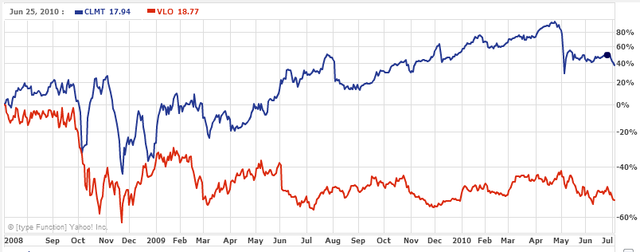
I couldn't resist posting this stock chart.... which reflects the 50% loss in stock value for Valero for this period of time.... but the potential drawback is that in the event the market and/or the economy returns to some normal state, the shareholders of CLMT are probably not going to see as much capital appreciation on the upside either.
So, if you are a bit conservative, and you still insist on being in this nasty, thankless refinery business, a small, stable, dividend paying alternative like CLMT might be a better way if you are willing to give up volatility and/or some upside in exchange for a consistent return.
Keep in mind that the world is full of perils, and there are no guarantees, as we are finding out every day.
:
Disclosure: none
Tuesday, June 29, 2010
The WNR/Giant Epic Fail
Per my post on Seeking Alpha, here are some more details on this deal by WNR to borrow over $1B in long term debt to buy the Giant refinery in Yorktown VA in 2007: This was such a monumentally bad deal that business students will be studying it for generations....
At the time the deal was made, the 70,000 bpd heavy crude refiner sold at $1.12B, which is almost $19,000 per BOD capacity. I can understand the desire for the company to increase its heavy crude refining capability, but the $19000 per BOD is greater than a lot of the greenfield projects were going at the time of the deal...
As we mentioned earlier, just to service this debt, the company needs $1.45 per barrel refining margins for the foreseeable future just to pay the debt, and a total of $13-14 to approach being an investment. Current is about $11, Assuming they wanted to make a profit on the deal, their internal analysis must have been telling them that the refining margins were going to be much higher than that....We all know how that worked out. To be fair, a reasonable analyst might have known that this level was pretty close to the long-term industry average for refining margin.....so maybe they were a bit of a victim of the recession.
At the current price of $5.30 per share, WNR can literally be purchased for the value of what they have in the tank farm, and that is probably optimistic. Assuming for the moment that you did this, you would in effect be buying the refining capacity of 220,000 barrels per day for the price of the $1.1B in debt. This comes out to about $5100 per BOD capacity, laughable in light of the $19000 per BOD capacity that they paid for Giant.
To continue the laughability, the Giant facility was bought when WNR was at about 45 per share. Since then nearly 90% of the market capitalization of the company has vanished. Assuming that same ratio, the same deal today might have been only $100M or so and could have been financed out of cash. Recently Valero sold their Delaware City refinery for $220M, at 220,000 bpd capacity this amounts to $1000 per BOD capacity. Timing is everything.
To further the thought exercise, the current value of Valero's 2.8 million barrels of refining capacity is $10.1B in market capitalization, which equates to about $3600 per BOD capacity, which is still greatly lower than the $5100 that WNR would be worth if you incurred the $1.1B debt, so you can assume from that that WNR is at least 40% overvalued at the current price.
WNR only has about $25M of cash on hand. They are 100% at the mercy of the people that they are using to roll over their debt. This debt could be restructured from the 11.25% per year that it currently is down to something more reasonable...somebody is going to have to take a writeoff.
WNR could, at some level, maybe $3 per share, be a buy for someone with deep pockets that could afford to take on the debt, or someone with a lot of credit at the current lower interest rates. FTO might be a candidate, no debt, lots of cash, similar business but in a different part of the country, but why would they? They might be able to get the desirable refinery later on if the company is split up. Valero: Forget it. They have too much capacity as it is......
It's interesting, the company is owned 40% by insiders, the remainder by the mutual fund people. Most of this group is institutionally owned at about 80%. I am thinking if this had been the case for WNR someone would have been a bit more conservative in their analysis, and thought better of the deal, or waited for a better price.
Unless the refining margins get to the highest levels in history for a sustained period, giving people some money, this will not go on much longer
At the time the deal was made, the 70,000 bpd heavy crude refiner sold at $1.12B, which is almost $19,000 per BOD capacity. I can understand the desire for the company to increase its heavy crude refining capability, but the $19000 per BOD is greater than a lot of the greenfield projects were going at the time of the deal...
As we mentioned earlier, just to service this debt, the company needs $1.45 per barrel refining margins for the foreseeable future just to pay the debt, and a total of $13-14 to approach being an investment. Current is about $11, Assuming they wanted to make a profit on the deal, their internal analysis must have been telling them that the refining margins were going to be much higher than that....We all know how that worked out. To be fair, a reasonable analyst might have known that this level was pretty close to the long-term industry average for refining margin.....so maybe they were a bit of a victim of the recession.
At the current price of $5.30 per share, WNR can literally be purchased for the value of what they have in the tank farm, and that is probably optimistic. Assuming for the moment that you did this, you would in effect be buying the refining capacity of 220,000 barrels per day for the price of the $1.1B in debt. This comes out to about $5100 per BOD capacity, laughable in light of the $19000 per BOD capacity that they paid for Giant.
To continue the laughability, the Giant facility was bought when WNR was at about 45 per share. Since then nearly 90% of the market capitalization of the company has vanished. Assuming that same ratio, the same deal today might have been only $100M or so and could have been financed out of cash. Recently Valero sold their Delaware City refinery for $220M, at 220,000 bpd capacity this amounts to $1000 per BOD capacity. Timing is everything.
To further the thought exercise, the current value of Valero's 2.8 million barrels of refining capacity is $10.1B in market capitalization, which equates to about $3600 per BOD capacity, which is still greatly lower than the $5100 that WNR would be worth if you incurred the $1.1B debt, so you can assume from that that WNR is at least 40% overvalued at the current price.
WNR only has about $25M of cash on hand. They are 100% at the mercy of the people that they are using to roll over their debt. This debt could be restructured from the 11.25% per year that it currently is down to something more reasonable...somebody is going to have to take a writeoff.
WNR could, at some level, maybe $3 per share, be a buy for someone with deep pockets that could afford to take on the debt, or someone with a lot of credit at the current lower interest rates. FTO might be a candidate, no debt, lots of cash, similar business but in a different part of the country, but why would they? They might be able to get the desirable refinery later on if the company is split up. Valero: Forget it. They have too much capacity as it is......
It's interesting, the company is owned 40% by insiders, the remainder by the mutual fund people. Most of this group is institutionally owned at about 80%. I am thinking if this had been the case for WNR someone would have been a bit more conservative in their analysis, and thought better of the deal, or waited for a better price.
Unless the refining margins get to the highest levels in history for a sustained period, giving people some money, this will not go on much longer
Subscribe to:
Posts (Atom)